
This gallery highlights books written or edited by current and former Cedarville University faculty members. It does not represent a comprehensive list of books by Cedarville faculty, but rather includes only those which have been brought to the attention of the University Archivist. Please contact the library to suggest additional titles.
-
A Commentary on Jeremiah
Michael B. Shepherd
The book that bears the prophet Jeremiah’s name does not merely document the past but looks forward to God’s future and final work in Christ. Perhaps more than any book of the Old Testament, Jeremiah attests to the process of its own writing, transmission, and editing, and these internal clues confirm its original purpose as a book for all time and for every nation.
/="/">
/="/">Michael Shepherd carefully lays out Jeremiah’s far-reaching message with passage-by-passage translation and up-to-date commentary. The themes of judgment and restoration certainly concern Israel’s historical judgment at the hands of the Babylonians and their subsequent return, but also the eschatological judgment of all worldly opposition to God and a final restoration and flourishing in the land of the covenant.
/="/">
/="/">Shepherd’s second volume in the Kregel Exegetical Library series, this commentary makes a significant contribution to the academic dialogue on the book of Jeremiah and its connections to the rest of Scripture. The exploration is helpful for the scholar but accessible and useful for the pastor, examining the themes of covenant, kingship, judgement, restoration, and the nations. -
A Commentary on the Book of the Twelve: The Minor Prophets
Michael B. Shepherd
The books of the twelve Minor Prophets are some of the least studied by Christians today, but they contain some of the great themes of Scripture, such as God's mercy and judgment, His covenant with Israel, the day of the Lord, and the coming of the Messiah. Arguing for a canonical unity that recognizes the Minor Prophets as one cohesive composition, Michael Shepherd explains the historical meaning of each verse of the twelve books and also provides guidance for application and preaching. Pastors, teachers, and serious students of Scripture will find a wealth of insights for understanding the Minor Prophets.
-
Daniel in the Context of the Hebrew Bible
Michael B. Shepherd
Commentators have long set the book of Daniel within the context of world history and the genre of apocalyptic literature. The present volume argues that the primary context for the book is the composition of the Hebrew Bible as a whole. Daniel in the Context of the Hebrew Bible has implications for every major hermeneutical issue in Daniel including the four kingdoms, the son of man, and the prophecy of seventy sevens. In the final analysis, the Hebrew Bible and the book of Daniel are decidedly messianic, eschatological, and faith-oriented
-
Textuality and the Bible
Michael B. Shepherd
Textuality and the Bible represents a concerted effort to clarify the object of study in biblical scholarship and in the church by bringing together the disciplines of hermeneutics, compositional analysis, canon studies, and textual criticism. It ultimately seeks to issue a call for study of the Bible for its own sake.
-
The Text in the Middle
Michael B. Shepherd
Analysis of inner-biblical exegesis ordinarily involves examination of the intertextual relationship between two texts within the biblical corpus. But in many cases there is an often overlooked intertext that serves as a bridge between the two texts. Such an intermediary text reads the primary text in a manner similar to the way the tertiary text reads it and supplies a missing link in a very subtle yet identifiable manner. The direction of dependence between texts of this kind is not as important in the present study as the direction in which these texts were meant to be read by those who gave them their final shape.
-
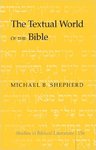
The Textual World of the Bible
Michael B. Shepherd
The world of the Bible is a textual world. Its composition and intertextuality are what make it a representation of reality. To understand biblical world making, it is important to understand how biblical books are made and read. The Textual World of the Bible explores the patterns of figuration in biblical composition and the way in which these patterns are read within the Bible (inner-biblical exegesis). This book is an excellent choice for courses in biblical theology and hermeneutics.
-
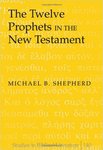
The Twelve Prophets in the New Testament
Michael B. Shepherd
It has been widely recognized that the Book of the Twelve, Hosea to Malachi, was considered a single composition in antiquity. Recent articles and monographs have discussed the internal clues to this composition, but there has been little effort to understand the way the New Testament authors quote from the Twelve in light of the compositional unity of the book. The Twelve Prophets in the New Testament contends that New Testament quotations from the Twelve presuppose knowledge of the larger whole and cannot be understood correctly apart from awareness of the compositional strategy of the Twelve.
-
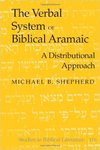
The Verbal System of Biblical Aramaic: A Distributional Approach
Michael B. Shepherd
Grammarians have been unable to provide a sufficient explanation for the verbal system of Biblical Aramaic by means of the standard categories of tense and aspect. Michael B. Shepherd exposes this situation and suggests a way out of the present impasse through distributional analysis by proposing that Biblical Aramaic has a primary verbal form for narration and a primary verbal form for discourse. This simple yet comprehensive proposal holds true not only for Biblical Aramaic but also for extra-Biblical Aramaic texts. This volume is an indispensable resource for courses in Biblical Aramaic and for anyone who wishes to read and understand the Biblical Aramaic corpus.