This gallery highlights books written or edited by current and former Cedarville University faculty members. It does not represent a comprehensive list of books by Cedarville faculty, but rather includes only those which have been brought to the attention of the University Archivist. Please contact the library to suggest additional titles.
-
The Heavens and The Earth: Excursions in Earth and Space Science
Marcus Ross, John Whitmore, Steven M. Gollmer, and Danny Faulkner
The Heavens and the Earth is a groundbreaking new textbook designed for the undergraduate, non-science major. Thoroughly Biblical in approach and content, it is the only college-level textbook in Earth and space sciences that advocates Biblical, young-Earth creationism while also fairly and respectfully presenting naturalistic views of history.
-
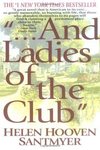
...And Ladies of the Club
Helen Santmyer
"...And Ladies of the Club" centers on the members of a book club and their struggles to understand themselves, each other, and the tumultuous world they live in. A true classic, it is sure to enchant, enthrall, and intrigue readers for years to come.
-
Farewell, Summer
Helen Santmyer
It's a long, languorous, country summer in a small Ohio town. After many years spent away as a scholar and writer, Elizabeth Lane has returned to the setting of her most poignant childhood memories, a town steeped in her family's long history. She comes to Sunbury to work on a book but finds she is haunted by one memory in particular. It was 1905, she was eleven and in love with her cousin, Steve, painfully watching his ill-fated romance with the beautiful Damaris. Looking back, Elizabeth discovers a world of feelings that she knows belong more to adulthood than childhood, and as she sees the tragic, doomed love of Steve and Damaris, she wishes she could be a child forever.
-
Herbs and Apples
Helen Santmyer
Herbs and Apples, the novel Helen Hooven Santmyer wrote at the height of her youthful creative powers, is the work that many critics have loved even more than . . . And Ladies of the Club. Laced with nostalgia as well as timeless insight into human character, Santmyer's enchanting novel is as contemporary today as the day it was written.
-
The Fierce Dispute
Helen Santmyer
Small-town America, ghosts, domesticity, and New World-Old World tensions - these combine in Helen Hooven Santmyer's second novel, The Fierce Dispute (1929), which feature a fiercely disputatious southern Ohio matriarch and her adult daughter locked in battle for the very soul of a child, Lucy Anne, from whose viewpoint much of the narrative unfolds.. "The Fierce Dispute pits Margaret Baird, the proud bearer of the Linley-Hewitt-Baird family history, against Margaret's cosmopolitan and romantic daughter, Hilary. Set in the Xenia, Ohio, family home, the novel's real battleground is Lucy Anne herself, the child mired in conflict because she loves both her mother Hilary and grandmother Margaret.
-
The Augustinian Theology of W.H. Auden
Stephen J. Schuler
When W.H. Auden returned to Christianity in the early 1940s, he identified himself with what he called an 'existential' method of spiritual and literary inquiry, which the writings of St. Augustine helped him define as a mode of thinking that not only allows for human subjectivity, but emphasizes the hopes, fears, needs, desires, and anxieties of the individual. Augustine thus became for Auden a model of a thinker who seamlessly merged psychological reflection with philosophical speculation and theological insight, and it is this combination of introspection and theoretical investigation that shapes much of Auden's later poetry. The Augustinian Theology of W.H. Auden illustrates that Augustine's thought is a major influence on Auden's postconversion poetry and prose. Auden encountered Augustine both directly, through his reading of the Confessions, and indirectly, through several of Auden's contemporaries, such as Reinhold Niebuhr, Charles Norris Cochrane, and Charles Williams. Stephen J. Schuler argues that Augustine provided Auden with the language of privation to describe the nature of moral and social evil, enabling him to make sense of the pervasive anxieties produced by World War II. Augustine's works also offered Auden a rationale for his intuition that the physical world, and especially the human body, is intrinsically good. Auden's struggle to reconcile the implications of his Augustinian theology with his attitudes toward romantic love and sexuality are explained by Schuler, who demonstrates how the Augustinian theology of Reinhold Niebuhr helped shape Auden's ideas about human identity and community, which is defined and maintained by love in all its various forms. Finally, Schuler analyzes Auden's Augustinian view of the ethics of poetry. By examining the presence of Augustinian ideas in Auden's poetry and prose, Schuler establishes the Augustinian origins of several crucial but often misunderstood features of Auden's work as well as the importance of Augustine in shaping and articulating the concerns of Auden's later poetry.
-
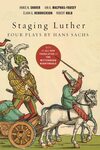
Staging Luther: Four Plays by Hans Sachs
Annis N. Shaver
The book contains four plays written by Hans Sachs, a troubadour, playwright, shoemaker, and important compatriot and supporter of Martin Luther.
Unlike Sachs' well-known poem "The Wittenberg Nightingale" (also included here in a new translation), the plays have not been translated into English until now and will be a boon for researchers and students who can now read them for the first time.
The plays are full of scriptural references and are generally written as dialogs between a Luther supporter and a Catholic cleric. Inevitably the Luther supporter wins the argument, but not without some name-calling and strong derision towards the Papist discussant!
In addition to the plays, the book provides historical commentary on the importance of Sachs' support of Luther, as well as annotations related to the translation and word choices along with cultural information to support the translations.
It is an important scholarly contribution to the ongoing work of reformation scholarship in the English language.