

-
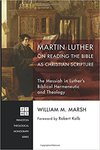
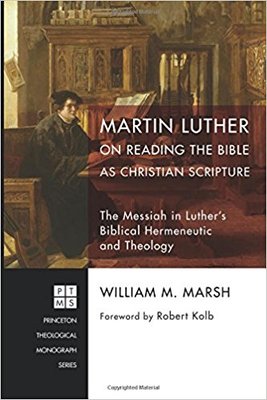
Martin Luther on Reading the Bible as Christian Scripture: The Messiah in Luther's Biblical Hermeneutic and Theology
William M. Marsh
Above all else that the sixteenth-century German Reformer was known for, Martin Luther was a Doctor of the Holy Scriptures. One of the most characteristic features of Luther's approach to Scripture was his resolved christological interpretation of the Bible. Many of the Reformer's interpreters have looked back upon Luther's "Christ-centered" exposition of the Scriptures with sentimentality but have often labeled it as "Christianization" particularly in regards to Luther's approach of the Old Testament, dismissing his relevance for today's faithful readers of God's Word. This study revisits this assessment of Luther's christological interpretation of Scripture by way of critical analysis of the Reformer's "prefaces to the Bible" that he wrote for his translation of the Scriptures into the German vernacular. This work contends that Luther foremost believes Jesus Christ to be the sensus literalis of Scripture on the basis of the Bible's messianic promise, not enforcing a dogmatic principle onto the scriptural text and its biblical authors that would be otherwise foreign to them. This study asserts that Luther's exegesis of the Bible's "letter" (i.e. his engagement with the biblical text) is primarily responsible for his conviction that Christ is Holy Scripture's literal sense.
-
Engage the Bible
William M. Marsh and Dan DeWitt
The book you’re holding could change your life. Not because it’s powerful in itself. It’s not. It’s designed to serve as a resource to help you Engage the Bible, the most important book, all year ‘round.
Take note, this devotional and Bible reading plan is pretty unique. It’s developed to give you a thirty-thousand-foot tour of the entire Bible from beginning to end. It explains and unpacks the major themes of the Old Testament and demonstrates how they all point to Christ, to a new covenant, and a new creation. Each week builds on the previous one, so you’ll want to go in order. And if you’re a youth pastor or pastor, this 52 week layout offers a great lesson plan for small group material.
The format for this devotional and Scripture reading plan and journal is simple. There’s a devotion for you to read at the beginning of each week with a simple prayer. There’s also a “Read the Bible Through” section that will give you passages to read and reflect on during the week. We’ve included a section in each spread for you to write down your thoughts and comments as you study God’s Word. The devotions and readings will take you from selected passages in Genesis through Revelation giving you an overview of the big story of the Bible. -
As It Was in the Beginning: An Intertextual Analysis of New Creation in Galatians, 2 Corinthians, and Ephesians
Mark D. Owens
Paul's comments regarding the new creation in 2 Cor 5:17 and Gal 6:15 have tended to be understood somewhat myopically. Some argue the phrase "new creation" solely refers to the inward transformation believers have experienced through faith in Jesus Christ. Others argue this phrase should be understood cosmologically and linked with Isaiah's "new heavens and new earth" Still others advocate an ecclesiological interpretation of this phrase that views Paul referring to the new community formed around Jesus Christ. In As It Was in the Beginning, Mark Owens argues that the concept of "new creation" should be understood (like the gospel) within the realm of Paul's anthropology, cosmology, and ecclesiology. At the same time, he also argues that Paul's understanding of new creation belongs within an Urzeit-Endzeit typological framework, especially within 2 Cor 5-6 and Eph 1-2. This reading of new creation attempts to give due weight to the use of Isaianic traditions in 2 Cor 5:17 and Eph 2:13, 17. Owens demonstrates that the vision of new creation in 2 Corinthians and Galatians is starkly similar to that of Ephesians.
-

Calling Out the Called
Paige Patterson, Thomas White, and L. R. Scarborough
Calling Out the Called is designed to assist those who are called to Christian service choose a place for equipping and preparation. It is also useful for pastors to give as a resource to the God-called men and women they are mentoring.
-
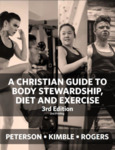
A Christian Guide to Body Stewardship, Diet and Exercise - 4th Edition
David D. Peterson, Jeremy M. Kimble, Trent A. Rogers, and Don Cameron Davis
This textbook provides readers with a wealth of practical information regarding body stewardship, nutrition, and exercise, all written from a Christian worldview. While other textbooks provide readers with the "why" proper nutrition and regular exercise is important, this textbook takes it one step further and provides readers with the "how". Each chapter is filled with helpful charts, tables, and figures that equip readers with tangible resources and recommendations they can use to put into practice the various concepts being introduced. Additionally, each chapter is written from a Christian worldview recognizing that the human body was created for a purpose, and through Godly stewardship of our bodies, we can more effectively worship our creator.
-
God and the Idols: Representations of God in 1 Corinthians 8-10
Trent A. Rogers
The interpretation of 1 Cor 8-10 as a coherent argument is complicated by several factors, most significantly the apparent contradictions in the text (primarily an issue within chapter 8) and the remarkable changes in Paul's tone (primarily an issue with how 10:1-22 relates to 8:1-13 and 10:23-11:1). Trent A. Rogers argues that Paul consistently prohibits believers from eating εἰδωλόθυτα by first appealing to their obligation to love other believers and then to their obligation of exclusive faithfulness to Christ. The approach of his analysis is to examine how the representation of God functions in Paul's argument, especially in comparison to other Hellenistic Jewish polemics against idolatry. While this is an argument made about particular practices, it is an argument made on theological grounds, and these theological underpinnings have been largely unexplored until now.